A fellow beekeeper, immeasurably more competent than I, accidentally killed his queen. The bees subsequently brought on a few queen cells to create a replacement. When he inspected the hive, he tore down all but one new queen cell... which he then broke as he reassembled the hive.
There but for the guilt of schadenfreude....
06 July 2010


30 June 2010
Grrrr
Max, the apiary warden, rang to say that there was a clump of bees dangling on the outside of the hive... The cast I had tried to unite with the colony seems to have decided not to join the fun.
Max has kindly offered to chuck 'em back in.
Max has kindly offered to chuck 'em back in.
Swarm capture


22 June 2010

Loss of journalist could be a boost to UK economy
In my highly scientific double-blind* numeric bumblebee survey, my garden is absolutely infested with the hairy buzzers, and I don't believe a word of this PANIC NOW journalism.
*both eyes closed - what do you expect, competence?
http://news.bbc.co.uk/1/hi/science_and_environment/10371300.stm

*both eyes closed - what do you expect, competence?
http://news.bbc.co.uk/1/hi/science_and_environment/10371300.stm

20 June 2010
A Practical Manual of Beekeeping
My best bee-reading to-date is A Practical Manual of Beekeeping: How to Keep Bees and Develop Your Full Potential as an Apiarist, by David Cramp.
Genuinely outstanding, and in parts very funny, too. Hugely recommended.

Genuinely outstanding, and in parts very funny, too. Hugely recommended.

18 June 2010
Budget Cuts Affect Beekeeping Shock
The wordy "When you earnestly believe you can compensate for a lack of skill by doubling your efforts, there's no end to what you can't do" has become the economical "Confusing effort with results."
16 June 2010
Daily Telegraph
Middle class fad for bee keeping sees doubling in number of hives
http://www.telegraph.co.uk/earth/earthnews/7808793/Middle-class-fad-for-bee-keeping-sees-doubling-in-number-of-hives.html
"The British British Beekeepers Association (BBKA) said there are now more than 80,000 hives registered in Britain, compared to 40,000 in 2007.
"The organisation said there has been an increase in the number of honey bees in Britain over the last two years from 23 billion to 48 billion."

http://www.telegraph.co.uk/earth/earthnews/7808793/Middle-class-fad-for-bee-keeping-sees-doubling-in-number-of-hives.html
"The British British Beekeepers Association (BBKA) said there are now more than 80,000 hives registered in Britain, compared to 40,000 in 2007.
"The organisation said there has been an increase in the number of honey bees in Britain over the last two years from 23 billion to 48 billion."

14 June 2010
Heater bees
Edited extract from http://www.bbc.co.uk/programmes/p007vrx7
Seen in the visible spectrum, all bees may look the same. In the infra-red spectrum, it is clear that some bees are warmer than others. Some glow bright orange like hot coals, radiating heat to their surroundings. Others are dark and cool.
Seen in the visible spectrum, all bees may look the same. In the infra-red spectrum, it is clear that some bees are warmer than others. Some glow bright orange like hot coals, radiating heat to their surroundings. Others are dark and cool.
Heat is concentrated in one central area of the hive, the brood nest, where young bee pupae are growing. A bee that may appear relatively still, when looked at in infra-red is glowing bright orange, revealing its role as a specialist heater bee.
The bee warms itself up by vibrating its flight muscles - vibrations that allow it to warm up to 44 degrees centigrade, previously thought to be high enough to kill it. Others that seem to be grabbing a quiet snooze are actually tight little balls of fire that are acting to keep the brood warm.
More than two thirds of the hive's honey goes on the central heating of the colony. A rarely seen moment is caught on camera when an exhausted heater bee is topped up by a refuelling bee just returned from foraging.
By controlling the temperature, heater bees control the destiny of the young. Incubated at 34 degress, the newly born bees are likely to become humble housekeepers, but kept just one and a half degrees warmer, they may instead turn into intelligent and high-ranking foragers, living up to 10 times longer.

13 June 2010

11 June 2010
Roots & Shoots
If you want to take people to see beehives, here's a wonderful organisation in South London: http://www.rootsandshoots.org.uk/wildlife-garden/school-visits.php


09 June 2010
Exeter Express & Echo - bumbling picture editor

http://www.thisisexeter.co.uk/news/best-bees/article-2280301-detail/article.html
08 June 2010
Article from The Telegraph: Calcutta

New Delhi, May 26: Concerns that cellphones pose a threat to honeybees, articulated by Shah Rukh Khan's character in My Name Is Khan, have now been bolstered by Panjab University zoologist Neelima Kumar's experiments. Read
Page url: http://www.telegraphindia.com/1100527/jsp/frontpage/story_12492728.jsp
© The Telegraph.
PS I promise I did not make this up!
Page url: http://www.telegraphindia.com/1100527/jsp/frontpage/story_12492728.jsp
© The Telegraph.
PS I promise I did not make this up!
07 June 2010
04 June 2010
Belfast Telegraph - bumbling picture editor...

http://www.belfasttelegraph.co.uk/news/environment/public-urged-to-revive-beekeeping-as-northern-ireland-honey-runs-out-14812047.html
01 June 2010

29 May 2010
Going Up!
 The existing colony has finally started to increase in numbers, and is drawing out fresh new brood comb. The plan had been (and still is) to replace the current brood box with an all-new deep box.
Replacing the current brood box with the deeper version adds about four inches (about 0.1016m, which shows you how useless SI units are for the real world) to the stack height. This being a WBC hive, to allow for the increase, I need one more lift.
Guess who forgot to bring the extra lift? See blog title for a clue.
Ground floor: perfumery
stationery and leather goods
wigs and haberdashery
kitchenware and food. Going up!
First floor: telephones
gents ready-made suits
shirts, socks, ties, hats
underwear and shoes. Going up!
Second floor: carpets
travel goods and bedding
material, soft furnishings,
restaurant and teas. Going down!
When to add supers...
The new swarm colony is going great guns. Clearly there are no new bees yet, so in theory the numbers are declining, but it doesn't look that way!
I put the swarm into a hive with a deep brood box and two supers. Naturally, after the event I discovered that you should not add supers until the brood box is fully drawn and filled with brood, honey and pollen. This ensures that the bees actually keep the stores below the excluder, where they will need them for winter.
Bugger.
See blog title for further information.
I put the swarm into a hive with a deep brood box and two supers. Naturally, after the event I discovered that you should not add supers until the brood box is fully drawn and filled with brood, honey and pollen. This ensures that the bees actually keep the stores below the excluder, where they will need them for winter.
Bugger.
See blog title for further information.
28 May 2010
Bill Turnbull: the bad beekeeper - Times Online

And I understand he has written a book, "The Bad Beekeepers' Club."
'Bad' is a strong word; how about 'naughty' or - let's say it - 'incompetent'?
22 May 2010
Jus' checkin'
Looked in on the new swarm today. The good news is that they have settled into their new home, rather than simply buggered off.
These new bees are *very* busy, and *very* aggressive. The slightest shake or knock, and a great swirl of bees pours up at me! Right now, they are building up the comb in the brood box, and already storing honey and pollen in half-built cells.
The first brood will be due to emerge in 24 days. I will check again on or around 12 June, which allows a few extra days for the comb to be completed.
By the look of them, these are Carnolian rather than black bees.
These new bees are *very* busy, and *very* aggressive. The slightest shake or knock, and a great swirl of bees pours up at me! Right now, they are building up the comb in the brood box, and already storing honey and pollen in half-built cells.
The first brood will be due to emerge in 24 days. I will check again on or around 12 June, which allows a few extra days for the comb to be completed.
By the look of them, these are Carnolian rather than black bees.
20 May 2010
Swarm
Phil kindly gave me a *huge* swarm he captured last night. At a rough guess, at least 1kg, which means around 10,000 bees.
The swarm is now in a WBC hive with deep brood box, and one super (drawn) above the queen excluder. I fed them with one litre of 1:1 syrup.
19 May 2010
Marie Celeste
 Page 184, Guide to Bees and Honey, 1997, by Ted Hooper...
"Often, this [robbing] will go on until the robbed colony is devoid of all stores, when they will starve or possibly all go home to the robbers' hive. I always think that this must be the way in which 'Marie Celeste' hives are produced - a hive in which a hive is completely empty of bees, stores and brood, but in which every cell is cleaned up and in perfect condition."
You heard it here last, naturally.
17 May 2010
14 May 2010
Q&A - bees in the birdbath
I was asked:
"[We] have a birdbath, large water-filled patio tubs and small saucer of water on our patio. Last year, and now this, we have found lots of bees trying to drink from these places, but have found a significant number drowning. We try to keep the water levels high, and have tried floating things in the water to help them get out if they fall in, but are concerned about the numbers drowning. We have lots of bees drinking on warm days and it can be a bit hard to get into the garden – and we don’t want to disturb them.
What can we do to help more bees survive?"
I answered:
"The best thing to stop bees drowning is to provide what I might best describe as a shallow ramp down into the water, like a very gentle beach. The bees will then walk forwards and drink from the damp edge, without drowning. Floaty things generally don't work.
If they are honey bees in your garden, they should not really bother you, but if there is a large colony (wild or kept) near-by, I can understand how it might be a bit of a pain. To stop the bees arriving, I suggest that from time to time you leave the bird bath dry for a while; the bees will soon (give it three days) learn to go elsewhere. You can then refill the birdbath, and repeat the trick if the bees rediscover it."
Any good?
"[We] have a birdbath, large water-filled patio tubs and small saucer of water on our patio. Last year, and now this, we have found lots of bees trying to drink from these places, but have found a significant number drowning. We try to keep the water levels high, and have tried floating things in the water to help them get out if they fall in, but are concerned about the numbers drowning. We have lots of bees drinking on warm days and it can be a bit hard to get into the garden – and we don’t want to disturb them.
What can we do to help more bees survive?"
I answered:
"The best thing to stop bees drowning is to provide what I might best describe as a shallow ramp down into the water, like a very gentle beach. The bees will then walk forwards and drink from the damp edge, without drowning. Floaty things generally don't work.
If they are honey bees in your garden, they should not really bother you, but if there is a large colony (wild or kept) near-by, I can understand how it might be a bit of a pain. To stop the bees arriving, I suggest that from time to time you leave the bird bath dry for a while; the bees will soon (give it three days) learn to go elsewhere. You can then refill the birdbath, and repeat the trick if the bees rediscover it."
Any good?
Best bad bee pun (-ish)
Readers' hives
http://www.telegraph.co.uk/gardening/beekeeping/7714885/Beekeeping-diary-queen-bee-finds-a-home.html
http://www.telegraph.co.uk/gardening/beekeeping/7714885/Beekeeping-diary-queen-bee-finds-a-home.html
11 May 2010
Why are bees stripey?
I was asked this by some schoolchildren. Here's my best shot.
The gene that expresses stripeyness in tigers is the same gene that expresses spottiness in leopards. All big cats carry very similar gene pools, and the individual genes are expressed differently in each species. (In the case of stripeyness in the big cats, it is governed by the genes controlling the size of the animal.)
If the same applies to hymenoptera, then hornets, wasps, bees, hoverflies etc will all (?) carry the stripeyness gene, expressed differently in each species. For example, apis and bombis express very different degrees of stripeyness.
Honeybees are mildly stripey because there is some mild survival value to carrying and mildly expressing the gene. Hornets are very stripey because there is big survival value to strongly expressing the gene. That's why bees are stripey - a bit obvious, really.
Is that right?
How and why did the gene arise, and what did it originally code?
The gene that expresses stripeyness in tigers is the same gene that expresses spottiness in leopards. All big cats carry very similar gene pools, and the individual genes are expressed differently in each species. (In the case of stripeyness in the big cats, it is governed by the genes controlling the size of the animal.)
If the same applies to hymenoptera, then hornets, wasps, bees, hoverflies etc will all (?) carry the stripeyness gene, expressed differently in each species. For example, apis and bombis express very different degrees of stripeyness.
Honeybees are mildly stripey because there is some mild survival value to carrying and mildly expressing the gene. Hornets are very stripey because there is big survival value to strongly expressing the gene. That's why bees are stripey - a bit obvious, really.
Is that right?
How and why did the gene arise, and what did it originally code?
05 May 2010
Los zánganos en la colmena
Norman Chapman (one of our Wimbledon beekeepers) has, with his daughter Valerie Rhenius and granddaughter Nina Asquith-Rhenius, published an elegant little book: Inside a Beehive.
Thirty-six pages are adorned with excellent photographs show every aspect of a hive. The text is in English, French and Spanish.
Recommended.
ISBN 978-1-907092-04-6.
PS The Spanish for "drones" is "los zánganos."
Thirty-six pages are adorned with excellent photographs show every aspect of a hive. The text is in English, French and Spanish.
Recommended.
ISBN 978-1-907092-04-6.
PS The Spanish for "drones" is "los zánganos."
23 April 2010
keeping bees

"keeping bees" by Paul Peacock is a longish (120pp+) attempt at a practical guide...
Not particularly well-organised or written, "keeping bees" is easily eclipsed by "Hive Management" by Richard E Bonney.
Next on my reading list is "Guide to Bees and Honey" by Ted Hooper.
14 April 2010
Covetousness
Every time I visit www.peak-hives.co.uk, I covet their beautiful, beautiful hives.
Remind me, which sin is that?
Remind me, which sin is that?
12 April 2010

08 April 2010
06 April 2010
"Jericho" not the best inspection method
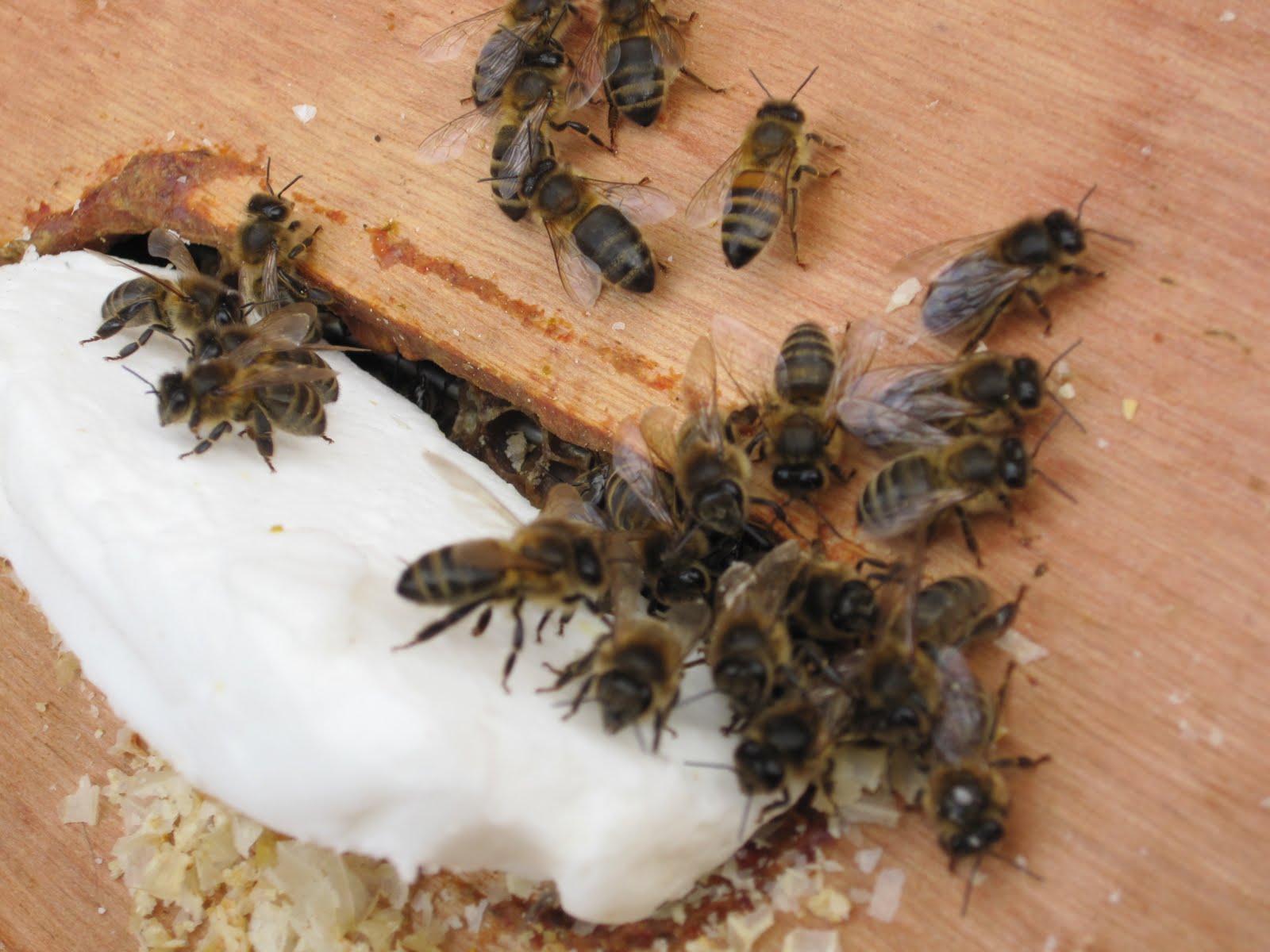
Finally, finally managed to find time to inspect the hives fully rather than the previous Jericho efforts.
As I thought, one hive failed to make it through the winter - except, of course, it was not the hive I was expecting...
Judging from the remains of the cluster, the colony that died was not large enough to keep warm. There were stores near-by, the comb etc looked healthy. The surviving colony already has many, many more bees.
As I thought, one hive failed to make it through the winter - except, of course, it was not the hive I was expecting...
Judging from the remains of the cluster, the colony that died was not large enough to keep warm. There were stores near-by, the comb etc looked healthy. The surviving colony already has many, many more bees.
23 March 2010
Bailey Comb Change
The current thinking is a Bailey Comb Change.
See http://www.wimbledonbeekeepers.co.uk/Bailey%20Comb%20Change.pdf
See http://www.wimbledonbeekeepers.co.uk/Bailey%20Comb%20Change.pdf
Bailey Comb Change

Nipped up to the apiary to take a look at the hives, as today was warm-ish.
Took the anti-woodpecker chicken wire off the hives, and took a peek in each. The hive nearest the gate looks pretty much dead. A mouse had somehow managed to lever the mouseguards open (you can see the nibble marks!) and ended up trapped above the crown board. The hive furthest from the gate looks busy, but I think it's robbery, not activity, as I could see no bees in the hive itself.
Prognosis: not good. One definitely dead, the other probably dead.
Took the anti-woodpecker chicken wire off the hives, and took a peek in each. The hive nearest the gate looks pretty much dead. A mouse had somehow managed to lever the mouseguards open (you can see the nibble marks!) and ended up trapped above the crown board. The hive furthest from the gate looks busy, but I think it's robbery, not activity, as I could see no bees in the hive itself.
Prognosis: not good. One definitely dead, the other probably dead.
16 March 2010
Jericho
Trying to find time to inspect the hives is proving tricky. The weather is so cold and wet that I dare not open the hives, and on the odd warmish day I have not had the time to take a look.
Instead, today was a Jericho inspection. Of the two hives, one seems to be busy in a suspicious kind of way, with lots of bees buzzing around, but not at the entrance (is it being robbed?), and the other seems fine, with a few bees milling around at the entrance.
The anti-woodpecker mesh seems to have done its job this year, at least.
Instead, today was a Jericho inspection. Of the two hives, one seems to be busy in a suspicious kind of way, with lots of bees buzzing around, but not at the entrance (is it being robbed?), and the other seems fine, with a few bees milling around at the entrance.
The anti-woodpecker mesh seems to have done its job this year, at least.
16 October 2009
Bees fight back against CCD: some honey bees toss out varroa mites

News like this and other updates from The Beekeepers Connection, a group on Linked In
14 October 2009

12 October 2009
Peak Hives

Here's a gratuitous plug for http://www.peak-hives.co.uk/.
I particularly like this site as (a) the owner reads this blog and (b) there is a pleasing disconnect between the skep site logo and the beautiful handmade hives.

09 October 2009
Vanishing of the Bees
The Vanishing of the Bees is the latest in a flood of bee films (http://vanishingbees.co.uk/)
Stretching credulity, Liam Gallagher presents a short promo on the plight of bees, complete with yoof swagger, Mockney and strange hand movements (see http://vanishingbees.co.uk/blog/liam_and_the_bees/).
08 October 2009
The Last Beekeeper

The bee population is steadily declining. Sure, bees can sting, but they also pollinate plants and fruit-bearing trees. Meaning we can't harvest our crops and grow successful gardens without them. "If all the bees die, what do you have to live for?" asks beekeeper Matt Hutchens.
The Last Beekeeper, produced by Fenton Bailey and Randy Barbato, follows the lives of three commercial beekeepers in South Carolina, Montana, and Washington. Over the course of a year they struggle to come to terms with the Colony Collapse Disorder (CCD), a phenomenon in which worker bees from a beehive or European honey bee colony abruptly disappear. CCD threatens crops and world food supply along with the livelihoods of beekeepers.
PS I was at school with Fenton, four million years ago (although only ten years ago for him, looking at his picture).
07 October 2009
Ask two beekeepers, get three answers.
You see, it would all be so much easier if (a) I remembered what I had already learned and (b) beekeeping was more science than art.
Max (apiary warden) and the bee inspector (David Rudland, I think) noted that the bees had particularly bad infestations of varroa. Part of the problem was that I had put the Apiguard trays on top of the crown board rather than on top of the brood box. This, I am told, makes it less effective. I know pefectly well that the Apiguard should go on the brood box. D'oh.
The second part of the problem was that some beekeepers think it makes no difference - it's purely whether the bees actually take their medicine, not whether it's on the crown board or brood box.
Ask two beekeepers, get three answers.
Max (apiary warden) and the bee inspector (David Rudland, I think) noted that the bees had particularly bad infestations of varroa. Part of the problem was that I had put the Apiguard trays on top of the crown board rather than on top of the brood box. This, I am told, makes it less effective. I know pefectly well that the Apiguard should go on the brood box. D'oh.
The second part of the problem was that some beekeepers think it makes no difference - it's purely whether the bees actually take their medicine, not whether it's on the crown board or brood box.
Ask two beekeepers, get three answers.
02 October 2009

30 September 2009
Varroa

Apiary inspection today, because foulbrood has been found within 4 miles (6km).
The apiary warden, Max, wrote "Both [your] hives have very bad varroa. You will see dead pupae and bees without wings. You need another treatment which needs to go on top of the brood box, not the super. Without further treatment the bees probably will not make it through the winter."
The apiary warden, Max, wrote "Both [your] hives have very bad varroa. You will see dead pupae and bees without wings. You need another treatment which needs to go on top of the brood box, not the super. Without further treatment the bees probably will not make it through the winter."
Thank you Max. I will be there in the morning.
25 September 2009
What makes a blog sticky?
In the early years of the internet, everyone talked about making their websites sticky. Talk of compelling content (porn), images (photoporn) and user interaction (chatporn) abounded.
What makes a blog sticky?
In my case, trying to extract around 90lbs of honey makes a blog sticky... and most of the kitchen, my hair, the computer keyboard and two small children, for a start.
Honey for home use is put in the nearest jar to hand. Tip top tip: clean former pickled gherkin jars with extra care...
What makes a blog sticky?
In my case, trying to extract around 90lbs of honey makes a blog sticky... and most of the kitchen, my hair, the computer keyboard and two small children, for a start.
Honey for home use is put in the nearest jar to hand. Tip top tip: clean former pickled gherkin jars with extra care...
16 September 2009
Wax moth is a consistent and vexing problem
 Some sources quote Galleria mellonela as the wax moth. Comparing photos with the moths on the comb, Achroia grisella is a closer physical match.
"Wax moth is a consistent and vexing problem in stored comb; the rate of moth development in a stack of stored supers rivals the imagination! "
Quote from http://en.wikibooks.org/wiki/Beekeeping/Wax_Moth, pic from http://www.uniprot.org/taxonomy/7137
14 September 2009
Moth disaster photos

And see the rest of the gory mess on the web (last few pics).
 |
| _____Diary of an_____ Incompetent Beekeeper |
Failed hive: the culprit...

Over the weekend I took the failed hive apart, comb by comb... and the culprit was Achroia grisella, or wax moth. [OK, the real culprit was my incompetence, but let's skip daintily onwards...]
The infestation was truly total. Oddly, despite killing off the colony, there was not a single dead bee in the hive. Had the bees flown back to the original hive (this was a shook swarm), or had they chosen not to return to the hive and died elsewhere?
The combs were *covered* in fine filaments, forming a dense, cottony network supporting the cocoons and that (I guess) bees cannot navigate. The whole hive had an intensely perfumed, almost headily sweet, smell.
Good info at http://www.honeybeelab.com/wiki/Fact_Sheet:Wax_moth_control_in_bee_hives and at http://en.wikipedia.org/wiki/Lesser_wax_moth
Pic from http://www.vc66.co.uk/mothweb/bnf1.htm, run by James Duffie
12 September 2009
CCD, Dave Hackenberg, religion

Found a 2007 report on CCD at http://www.manataka.org/page1705.html The piece was written by Linda Moulton Howe. She has her own site, http://www.earthfiles.com/, if you like that kind of thing.
It quotes Dave Hackenberg, often credited as the first person to raise the alert on CCD. His commercial colonies suffer a very great deal from CCD, it seems, which may tell us something.
The Manataka site (http://www.manataka.org/) is full of piffle. I particularly like the homepage image, which (probably unconsciously) demonstrates how religions/cults/kabals/nutjobs and the rest borrow iconography from a single core theme (open hands, rays of light etc).
08 September 2009
Manuka and pseudoscience

I often read claims about honey that I find somewhat dubious, to say the least. Following a comment (see below) from Manuka Honey Health (http://www.manukahoneyhealth.co.uk/), I thought it might be jolly to find out more about manuka.
Manuka is the common name for Leptospermum scoparium, or the tea tree to you and me (see http://en.wikipedia.org/wiki/Leptospermum_scoparium), as in tea tree oil, tea tree shampoo, tea tree tea (OK, I made that one up).
There is no evidence for manuka honey or any monofloral honey (rape? heather?) being better for you, in any way, than multifloral honey. If there is evidence, let's see it.
One last thought: honey is, in so many words, bee-sick, or perhaps bee-spit.
27 August 2009
Straight dope (no, not that kind...)

Curious article from pre-history, namely May 2007, about why bees are disappearing.
Straight dope = information without adulteration or rigid kind of marujana or honest but stupid person?
Waggledance

Every time I visit the hives, I suit up top-to-toe -- and still the little buggers manage to get through!
A couple of bees were caught in the suit material by my shoulders, and stung me right on the collar-bone. I can now do my very own waggledance.
17 August 2009
Mary Celeste

Visited the hives on Saturday, and one (of three) was eerily quiet. Checked inside...
What seems to have happened is this:
- This hive had the shook swarm, with relatively few bees
- There are *tons* of wasps this summer
- On last inspection, I noticed (and killed) many wasps
- On last inspection, I closed up the hive entrance to help the bees defend the colony
- The wasps won the battle...
OR
- This hive had the shook swarm, with relatively few bees
- The flying bees returned to the old hive
- Leaving an enfeebled colony, which died out
On the previous inspection there were plenty of bees and a laying queen. I will take the hive to bits and inspect more closely.
11 August 2009

10 August 2009
Pollen, honey and hay fever
 Ian Douglas, who "writes about technology, science, the internet and beekeeping" in the Telegraph, says (and I agree) that honey does not cure hay fever.
 He writes "Honey does not contain pollen." Oh Yes It Does. His theory is that because honey does not contain pollen, it will be no good in a homeopathicky way to cure hay fever.
He goes on to add a proper argument, citing a small trial, http://www.ncbi.nlm.nih.gov/pubmed/11868925, the conclusion of which was "This study does not confirm the widely held belief that honey relieves the symptoms of allergic rhinoconjunctivitis." My only caveat is the small (36) sample size.
05 August 2009
Beehaus & caravan accessories

A new version of Beehaus has been launched. It's a pity that it looks like a 1970s caravan accessory.
In my view, Beehaus is a good idea, because (a) it promotes beekeeping and (b) hive design has been static for years, and Beehaus may move it onwards. The basic design changes in Beehaus are (1)rectangular boxes of five frames each, which allows incremental expansion, and (2) full-depth division board to allow two hives on the same stand.
I use WBC hives - the ones with the sloping sides - probably the worst and most annoying. If I'm feeling flush, I might buy a Beehaus one day to try it out.
More details from http://www.omlet.co.uk/, and that's the photo source, too.
03 August 2009

01 August 2009
Propolis, pollen and pseudoscience

Yes, yet more pseudoscience, this time from Rainbow Wellbeing (http://www.rainbowwellbeing.com/):
A source of youth and vitality?
This is the question that many worldwide scientists have been asked about bee pollen and propolis, substances from which bee bread is made. Researchers in Russia have investigated the long living people of the Caucasus region and found that most of them were bee keepers too poor to eat the clear honey, which they sold locally, they however ate the scraps of honey and pollen (bee bread) found at the bottom of the hive. It was concluded that eating these scraps, which were almost pure pollen was the reason for their longevity.
Carlson Wade writes in his book Bee Pollen and Your Health, "Two of the greatest gerontologists of the USSR, professors Nikita Mankoysky and D. G. Chebotarev, have also found that pollen is able to cause self-renewal or rejuvination and add years to the life span."
(a) bee bread is not almost pure pollen [that would be called 'pollen'], it is pollen, honey and all kinds of things, such as fungi and bacteria
(b) citing a researcher is from Foreign Parts with a funny-sounding name does not make the research valid (see http://mellifera.blogspot.com/2009/07/ever-wondered-how-bee-is-able-to-fly.html)
(c) quoting from a book does not make the evidence any better than asking your granny (I should know, I have written two books)
(d) most importantly, hens' teeth in a light suspension of snake oil is much more effective than propolis and pollen at extending human lifespan (I should know, I am 371 years old and from the far galaxy came I did).
So there.
A source of youth and vitality?
This is the question that many worldwide scientists have been asked about bee pollen and propolis, substances from which bee bread is made. Researchers in Russia have investigated the long living people of the Caucasus region and found that most of them were bee keepers too poor to eat the clear honey, which they sold locally, they however ate the scraps of honey and pollen (bee bread) found at the bottom of the hive. It was concluded that eating these scraps, which were almost pure pollen was the reason for their longevity.
Carlson Wade writes in his book Bee Pollen and Your Health, "Two of the greatest gerontologists of the USSR, professors Nikita Mankoysky and D. G. Chebotarev, have also found that pollen is able to cause self-renewal or rejuvination and add years to the life span."
(a) bee bread is not almost pure pollen [that would be called 'pollen'], it is pollen, honey and all kinds of things, such as fungi and bacteria
(b) citing a researcher is from Foreign Parts with a funny-sounding name does not make the research valid (see http://mellifera.blogspot.com/2009/07/ever-wondered-how-bee-is-able-to-fly.html)
(c) quoting from a book does not make the evidence any better than asking your granny (I should know, I have written two books)
(d) most importantly, hens' teeth in a light suspension of snake oil is much more effective than propolis and pollen at extending human lifespan (I should know, I am 371 years old and from the far galaxy came I did).
So there.
31 July 2009

30 July 2009
eye of the beeholder

Did I publish this link? http://eyeofthebeeholder.blogspot.com/
The Eye of the Beeholder is probably the blog I meant to write, if you know what I mean... Good info on bees, plenty of pictures, and written with both wit and charm.
Dang!
29 July 2009
Ever wondered how a bee is able to fly?

""We're no longer allowed to use this story about not understanding bee flight as an example of where science has failed, because it is just not true," Dickinson* says.
The secret of honeybee flight, the researchers say, is the unconventional combination of short, choppy wing strokes, a rapid rotation of the wing as it flops over and reverses direction, and a very fast wing-beat frequency.
Read more at http://www.physorg.com/news8616.html
*Michael H. Dickinson, the Esther M. and Abe M. Zarem Professor of Bioengineering (and his postdoctoral student Douglas L. Altshuler and their colleagues at Caltech and the University of Nevada at Las Vegas).
28 July 2009

27 July 2009
Are my bees too big for the queen excluder?
In one hive there were probably twenty worker bees stuck half-way through the queen excluder. They had starved to death, I think.
Are my bees too big for the queen excluder?
Are my bees too big for the queen excluder?
Honey crop - so far
From two hives, three supers in total. In the third hive there are three more full supers, none fully capped.
24 July 2009

23 July 2009
Andrew's Bee Blog

We're all out there doing our stuff: http://andrewsbeeblog.com/
Click on the link to the swarm capture, then click on the photos for a neat slide show.
21 July 2009
Not so urban

Good bee blog here: http://urbanhennery.com/2009/07/11/and-the-hive-drama-continues/
Satisfying levels of calm incompetence, describing the difficulties of uniting hives and the bees simply not going along with it. Generally, a pleasing blog, beautifully presented.
20 July 2009
Bees in Space (I am not making this up)

On the 40th anniversary of the first moon landing, I searched for 'bees in space.' And Oh Yes, there is a site: http://www.beesinspace.org/
You might like http://wechoosethemoon.org/, too, or http://www.google.com/moon/