25 February 2007
BeeData
Discovered: http://www.beedata.com/ a useful collection of information and links, particularly the news page
21 February 2007
Hornet death squads menace
 The French honey industry is under threat from hoards of bee-massacring oriental hornets, the Daily Telegraph reports.
The forests of Aquitaine, in south-west France, now play host to swarms of the the Asian Hornet, Vespa velutina, which is believed to have arrived there "from the Far East in a consignment of Chinese pottery in late 2004".
Entomogist Jean Haxaire, who first eyeballed the invaders, said: "Their spread across French territory has been like lightning."
Haxaire said he's now counted 85 "football-shaped" nests across the 40 miles which separate the towns of Marmande and Podensac "in the Lot et Garonne department where the hornets were first spotted".
The Asian Hornet can cause some serious damage to a human, "inflicting a bite which has been compared to a hot nail entering the body". But that's not the principal threat they pose. They can decimate a nest of 30,000 bees "in a couple of hours" in search of larvae on which to feed their young. This, unsurprisingly, gives local beekeepers serious cause for alarm.
The hornets are just the latest blow to the French beekeeping industry. Pesticides and hot summers have taken their toll on bee populations, and a spokesman for the French National Bee Surveillance Unit said the winter mortality rate among bees had risen to six in ten.
Accordingly, honey production has been hit hard - down 60 per cent in south-western France in the last 10 years. The country's 1.3 million hives, managed by 80,000 beekeepers, are unable to supply demand and France now imports 25,000 tonnes of honey annually.
The Bee Surveillance spokesman lamented: "The arrival of these hornets has made the situation considerably worse. The future of our entire industry is at stake."
In Britain, meanwhile, it looks like we'd better start stockpiling honey. Stuart Hine, manager of the Insect Information Service at London's Natural History Museum, warned: "There's no doubt that these hornets are heading north and will probably find their way to Britain at some point."
There is, however, some hope for Blighty. While Hine confirmed climate change meant the hornets would find summers very much to their liking, "they would still have difficulty coping with our winter frosts". ®
BootnoteApparently, 40 people die each year in France as a result of hornet stings, "mainly because of allergic reactions". Claire Villement, of France's Natural History Museum, has called for calm and asked citizens not to succumb to "national panic about killer wasps". "The legend that three bites from a hornet can kill you are totally false. People can still enjoy their picnics in the countryside."
As seen in both The Register http://www.theregister.co.uk/2007/02/21/killer_hornets/ and in The Daily Telegraph http://www.telegraph.co.uk/news/main.jhtml;jsessionid=DI3TUYKFGGADXQFIQMFCFF4AVCBQYIV0?xml=/news/2007/02/21/whornets21.xml
18 February 2007
15 February 2007
Mysterious illness stings beekeepers
FROM http://www.detnews.com/apps/pbcs.dll/article?AID=/20070215/BIZ/702150353/1020/NATION
(Sent to me by Jim Burke, The Bronze Group, LLC, www.thebronzegroup.com - thank you, Jim)
Scientists looking into a mysterious ailment killing off honeybees are hoping to find answers out West, where bees are currently helping pollinate California's profitable almond crop.
Beekeepers from around the country each year flock to the Golden State this time of year, releasing their insects to jump-start the $1.4 billion California almond crop.
Researchers hope the diversity gives them a large sample from which to figure out why some bees remain healthy while others become afflicted with an illness called colony collapse disorder.
The ailment has killed off tens of thousands of honeybee colonies in at least 21 states, researchers said, threatening the livelihood of commercial beekeepers and potentially putting a strain on fruit growers and other farmers that rely on bees to pollinate their crops.
The expedition to California couldn't have come at a better time for researchers scrambling for answers. About half of the nation's available commercial bees are transported to California each February for the task, when trees burst with light pink-and-white blossom.
Marsha Venable, spokeswoman for the Almond Board of California, which represents growers, said a group task force assigned to monitor the situation found that there was no bee shortage this year.
"There's a sense of comfort of enough bees to do the job," Venable said Monday by phone. California accounts for 80 percent of the world's almonds, according to that state's food and agriculture department.
But bee researchers from Pennsylvania and Montana who have spent the last couple weeks in California collecting test samples said they have heard stories of beekeepers having lost colonies by the thousands, forcing them to return home with no work and few bees.
"One yard had colonies that were failing. One was one of the worst cases we've seen," University of Montana bee researcher Jerry Bromenshenk said in a phone interview Monday. "That's why we are all focused in California at this point."
Michigan had first signs of illness
The first report of colony collapse disorder came to researchers at Penn State University in November, though scientists now think that the problem may have been around as early as a couple years ago.
Bromenshenk is also president of Bee Alert Technology Inc., a Missoula, Mont.-based firm that is surveying beekeepers to determine the geographic extent of the problem.
While there are no definitive answers, he said survey results so far show the first signs of the illness may have popped up in Michigan, Wisconsin and Iowa.
(Sent to me by Jim Burke, The Bronze Group, LLC, www.thebronzegroup.com - thank you, Jim)
Scientists looking into a mysterious ailment killing off honeybees are hoping to find answers out West, where bees are currently helping pollinate California's profitable almond crop.
Beekeepers from around the country each year flock to the Golden State this time of year, releasing their insects to jump-start the $1.4 billion California almond crop.
Researchers hope the diversity gives them a large sample from which to figure out why some bees remain healthy while others become afflicted with an illness called colony collapse disorder.
The ailment has killed off tens of thousands of honeybee colonies in at least 21 states, researchers said, threatening the livelihood of commercial beekeepers and potentially putting a strain on fruit growers and other farmers that rely on bees to pollinate their crops.
The expedition to California couldn't have come at a better time for researchers scrambling for answers. About half of the nation's available commercial bees are transported to California each February for the task, when trees burst with light pink-and-white blossom.
Marsha Venable, spokeswoman for the Almond Board of California, which represents growers, said a group task force assigned to monitor the situation found that there was no bee shortage this year.
"There's a sense of comfort of enough bees to do the job," Venable said Monday by phone. California accounts for 80 percent of the world's almonds, according to that state's food and agriculture department.
But bee researchers from Pennsylvania and Montana who have spent the last couple weeks in California collecting test samples said they have heard stories of beekeepers having lost colonies by the thousands, forcing them to return home with no work and few bees.
"One yard had colonies that were failing. One was one of the worst cases we've seen," University of Montana bee researcher Jerry Bromenshenk said in a phone interview Monday. "That's why we are all focused in California at this point."
Michigan had first signs of illness
The first report of colony collapse disorder came to researchers at Penn State University in November, though scientists now think that the problem may have been around as early as a couple years ago.
Bromenshenk is also president of Bee Alert Technology Inc., a Missoula, Mont.-based firm that is surveying beekeepers to determine the geographic extent of the problem.
While there are no definitive answers, he said survey results so far show the first signs of the illness may have popped up in Michigan, Wisconsin and Iowa.
12 February 2007
Bees on the web
This is a loooong 10min video of a beekeeper catching a swarm. Ignore the first half, the camera is all over the place: I suggest you start watching from five minutes and onwards http://www.youtube.com/watch?v=9RBL9vnhRag
Bristol bees
Bristol Zoo (http://www.bristolzoo.org.uk/) has an unusual beehive: three frames set one above the other in a glass case. The top comb, not seen here, was covered with active bees. I spotted a not particularly big queen, marked with a green dot. The middle comb, in the video, had relatively few bees on it and the foundation was incomplete as you can see. The lowest frame was empty of bees and was very dark, old comb.
You can see in from both glass sides, though not very clearly. There were probably not more than a few thousand bees in total. It was a very cold day (Sunday 11 February), but the bees were flying. I suspect the colony was fooled by the warmth of the hive, which is inside.
http://www.bristolzoo.org.uk/learning/animals/invertebrates/bee
The mathematics of beekeeping
The queen lays around 1,500 eggs a day, peak season. Assuming 100% breeding success, in a typical month of thirty days she produces 45,000 new bees (1,500 x 30).
I'm guessing that the summer peak season lasts for four months, with an average of 1,500 eggs/day. For the remaining eight months, let's say there are four months of not-so-peak egg laying of 750 eggs/day on average, and four months of very little activity of 375 eggs/day on average.
If the figures are roughly correct, yearly egg production might be like this:
4 months x 30 days x 1,500 eggs/day = 180,000
PLUS
4 months x 30 days x 750 eggs/day = 90,000
PLUS
4 months x 30 days x 375 eggs/day = 45,000
EQUALS
An amazing 315,000 bees produced per year.
In winter, if the queen is producing low numbers of eggs or even none at all, the hive comes perilously close to extinction, because the bees will be dying more quickly than she is laying. During winter, the bees must live longer, or the hive would die off.
Looked at another way, if the queen lasts five years, she produces more than 1,500,000 eggs during her lifetime.
I'm guessing that the summer peak season lasts for four months, with an average of 1,500 eggs/day. For the remaining eight months, let's say there are four months of not-so-peak egg laying of 750 eggs/day on average, and four months of very little activity of 375 eggs/day on average.
If the figures are roughly correct, yearly egg production might be like this:
4 months x 30 days x 1,500 eggs/day = 180,000
PLUS
4 months x 30 days x 750 eggs/day = 90,000
PLUS
4 months x 30 days x 375 eggs/day = 45,000
EQUALS
An amazing 315,000 bees produced per year.
In winter, if the queen is producing low numbers of eggs or even none at all, the hive comes perilously close to extinction, because the bees will be dying more quickly than she is laying. During winter, the bees must live longer, or the hive would die off.
Looked at another way, if the queen lasts five years, she produces more than 1,500,000 eggs during her lifetime.
11 February 2007


10 February 2007

07 February 2007
Frosties

Very cold today - and an extremely hard frost, as this picture absolutely fails to show. BeeCraft magazine and our own WBKA newsletter full of dire warnings about overwintering and the likelihood that come the end of March they'll all be dead.
01 February 2007
Good work fella
From BeeCraft, The Official Journal of the British Beekeepers' Association, February 2007, in the article "Wirral Beekeepers' Polish Expedition 2006," page 13:
"During the last evening in the hotel the group danced to a local duo till the early hours and then set off the next day to travel north again. The hotel had to send out for another barrel of beer and the staff said the bar takings were the best ever."
Hats off to article author Doug Jones, Secretary, Wirral Branch, Cheshire Beekeepers' Association. Good work fella.
http://www.bee-craft.com/ and http://www.cheshire-bka.co.uk/ (great site)
24 January 2007

12 January 2007
Bee resolutions
Two new year resolutions:
1> Pull a finger out and wrap the chicken wire round the hive
2> Harvest at least 10kg of honey this year
I might add "Don't get stung again," but that seems a step too far!
1> Pull a finger out and wrap the chicken wire round the hive
2> Harvest at least 10kg of honey this year
I might add "Don't get stung again," but that seems a step too far!
23 December 2006
Bee Happy this Christmas!
Wishing all members of The Wimbeldon Beekeepers' Association a very Happy Christmas and wonderful New Year.
11 December 2006
Windy miller
With the gale of the last few days, I have been very slow checking that the roof of the hive has not blown off. The lid is still there, as the hive is in a sheltered position and the WBC hive roof is quite substantial.
No bees flying. It's about 10C today, and the first frosts of winter are leaving a tracery of ice on exposed surfaces.
Brrrr.
No bees flying. It's about 10C today, and the first frosts of winter are leaving a tracery of ice on exposed surfaces.
Brrrr.
04 December 2006
Wimbledon Beekeepers' Association Honey Show
All I ask is that you pay close attention to Peter Bashford's tie. True dedication to Beekeeping.
(Send me a comment [click the COMMENT link below] if you would like any of the original pictures, which are a great deal sharper than the video.)
(Send me a comment [click the COMMENT link below] if you would like any of the original pictures, which are a great deal sharper than the video.)
Wimbledon Beekeepers' Association Honey Show
The Annual Honey Show tonight, judged by Peter Bashford (in the white coat) and assisted by Phil Barnes. Peter Bowbrick presided over the prizegiving, Charlotte Winterborn welcoming guests and competitors.
Owing to a slight misunderstanding - principally me not reading the instructions properly - I had not realised that despite having no honey this year, I could still have entered for a competition class. Number 17, "A Decorative, Artistic or Creative Exhibit relating to Bees or Beekeeping." Put another way, no real need to keep bees. Right up my street. Next year, perhaps...
The best exhibit was the mead (made by Vladimir Berka), particularly the Dry. Very nice. A bit like Madeira.
Suddenly, beekeeping has a purpose...
Owing to a slight misunderstanding - principally me not reading the instructions properly - I had not realised that despite having no honey this year, I could still have entered for a competition class. Number 17, "A Decorative, Artistic or Creative Exhibit relating to Bees or Beekeeping." Put another way, no real need to keep bees. Right up my street. Next year, perhaps...
The best exhibit was the mead (made by Vladimir Berka), particularly the Dry. Very nice. A bit like Madeira.
Suddenly, beekeeping has a purpose...
20 November 2006
Of mice and men - and bees
Finally got around to putting the mouse guard in place at the front of the hive.
It was a very cold day, around 10C or lower, and there were no bees flying at all, and I couldn't see or hear any bees.
The mouse guard is the normal entrance bar, reversed. This meant first unsticking the entrance bar, by giving it quite a clout and prying it free with the hive tool (the bees had glued it in place with propolis).
As soon as I hit the hive, a great blob of bees appeared at the entrance, looking for trouble to guard the hive from attack.
Fortunately, it was so cold that the bees were very lethargic, and though they were flying up to attack it was a bit half-hearted.
Once again, though, the smoker went out!
That's it for the winter now. Fingers crossed, they will survive the winter and will be happy and healthy in March or so.
It was a very cold day, around 10C or lower, and there were no bees flying at all, and I couldn't see or hear any bees.
The mouse guard is the normal entrance bar, reversed. This meant first unsticking the entrance bar, by giving it quite a clout and prying it free with the hive tool (the bees had glued it in place with propolis).
As soon as I hit the hive, a great blob of bees appeared at the entrance, looking for trouble to guard the hive from attack.
Fortunately, it was so cold that the bees were very lethargic, and though they were flying up to attack it was a bit half-hearted.
Once again, though, the smoker went out!
That's it for the winter now. Fingers crossed, they will survive the winter and will be happy and healthy in March or so.
23 October 2006
All set for winter
Checked the hive yesterday - cold and wet. Four bees were sitting quietly at the hive entrance keeping guard, otherwise no activity.
Later this week I will replace the hive entrance bars with a mouseguard (apparently mice will get in during winter and eat bees, honey and wax) and then wrap the hive in chicken wire to keep the woodpeckers away (am I being gullible here?).
Later this week I will replace the hive entrance bars with a mouseguard (apparently mice will get in during winter and eat bees, honey and wax) and then wrap the hive in chicken wire to keep the woodpeckers away (am I being gullible here?).
17 October 2006
Bee recognised
After a short holiday, I have not opened the hive for a couple of weeks now. From the outside, they seem busy enough, which is a good sign.
On holiday a person asked me if I always wear protective clothing, or if the bees now recognise me. Recognise me? "Oh, hello! Aren't you the twit that keeps dropping frames and messing up our lovely hive?"
Exit Incompetent Beekeeper, pursued by a bee.
On holiday a person asked me if I always wear protective clothing, or if the bees now recognise me. Recognise me? "Oh, hello! Aren't you the twit that keeps dropping frames and messing up our lovely hive?"
Exit Incompetent Beekeeper, pursued by a bee.
25 September 2006
How many bees does it take...
Looking at the video below, I counted 44 arrivals in one minute.
If the bees are active for ten daylight hours (08:00 to 18:00) at 40 arrivals a minute, there are 24,000 arrivals per day.
A colony might produce 25kg of honey in a summer. To do so, each bee brings a load of about 5 microgrammes of nectar or pollen back to the hive per trip, minimum.
In fact, a great deal of the nectar and pollen brought into the hive does not contribute to honey production (it actually produces more bees, honeycomb wax, propolis and bee poo), so either there are more trips or they carry more per trip.
And in a hive of (say) 50,000 bees, not all will be at the fetch-and-carry stage...
Thought you might like to know.
If the bees are active for ten daylight hours (08:00 to 18:00) at 40 arrivals a minute, there are 24,000 arrivals per day.
A colony might produce 25kg of honey in a summer. To do so, each bee brings a load of about 5 microgrammes of nectar or pollen back to the hive per trip, minimum.
In fact, a great deal of the nectar and pollen brought into the hive does not contribute to honey production (it actually produces more bees, honeycomb wax, propolis and bee poo), so either there are more trips or they carry more per trip.
And in a hive of (say) 50,000 bees, not all will be at the fetch-and-carry stage...
Thought you might like to know.
Beekeeping at its best?
A friend, Sam, has been keeping bees for several years now. This is his Incompetent Beekeeping track record:
Three WBC hives this year, only one colony alive
No honey this year
No honey last year
Stung every time he opens the hive
My faith in Incompetent Beekeeping is alive and well - unlike most of his bees.
Three WBC hives this year, only one colony alive
No honey this year
No honey last year
Stung every time he opens the hive
My faith in Incompetent Beekeeping is alive and well - unlike most of his bees.
22 September 2006
19 September 2006
Bee stings and tee shirts
Bee stings are, I now know, very painful - and I haven't even been stung, yet.
It turns out that the bees can *almost* sting through the bee suit. During the spectacularly incompetent insertion of the varroa treatment (see two entries below), the bees became very, very upset.
During the excitement I felt some sharp pricks - a bit like being nipped by a horsefly - on my forearms. I was wearing a tee shirt under the bee suit, and on all other occasions I have been wearing a long-sleeved suit.
This was four days ago, and I still have great hard red blotches on my arms.
With one layer of cotton between me and a bee, it turns out that their barb is *just* long enough to reach my skin, and *not quite* long enough to inject the venom for a full sting.
Hmmmm. Not quite sure if this counts as "unstung so far" or "lucky escape."
Toby Chapman-Dawe
It turns out that the bees can *almost* sting through the bee suit. During the spectacularly incompetent insertion of the varroa treatment (see two entries below), the bees became very, very upset.
During the excitement I felt some sharp pricks - a bit like being nipped by a horsefly - on my forearms. I was wearing a tee shirt under the bee suit, and on all other occasions I have been wearing a long-sleeved suit.
This was four days ago, and I still have great hard red blotches on my arms.
With one layer of cotton between me and a bee, it turns out that their barb is *just* long enough to reach my skin, and *not quite* long enough to inject the venom for a full sting.
Hmmmm. Not quite sure if this counts as "unstung so far" or "lucky escape."
Toby Chapman-Dawe
18 September 2006
Bee careful
 The bees have built up comb linking the brood box to the super above it - with some exciting results for an Incompetent Beekeeper!
When I lift the top box off (the 'super'), some of the frames in the brood box below are stuck to it. The first time I lifted the super without realising this, the lower frames broke off when I had the super about a foot in the air. The frames that I had unwittingly dragged out of the brood box dropped back down into the brood box with a clunk, upsetting the bees more than somewhat.
This photo is a shot of the top of the brood box, covered in very annoyed bees, honey, broken comb and brood.
Live and fail to learn, that's the Incompetent Beekeeper motto.
Toby Chapman-Dawe
16 September 2006
Bee attack!
Two tasks this morning: replace the feeder with more syrup, and insert a varroa treatment disc.
Right from the beginning, the bees were not happy. I opened the hive at around noon, and the bees immediately burst up towards me - quite alarming.
Then, after separating the brood and super boxes (to insert the varroa disc), even more bees launched themselves at me...
The comedy pink frills on the gloves were definitely not helping, with tens of bees tangled up in them, buzzing furiously. And all the time more bees were leaving the open hive and banging into me...
It's difficult to describe when you have maybe 100+ bees trying to sting you. Worrying?
I put the hive back together, sharpish, put the syrup feeder on top, plonked the lid on and legged it.
Twenty minutes later, the bees were still attacking me, although I was now 20 metres from the hive. Eventually they stopped, and even then I got one stuck in my hair - again.
Not nice.
I had just come back from a short jog, and was very sweaty. Maybe they reacted.
Toby Chapman-Dawe
Right from the beginning, the bees were not happy. I opened the hive at around noon, and the bees immediately burst up towards me - quite alarming.
Then, after separating the brood and super boxes (to insert the varroa disc), even more bees launched themselves at me...
The comedy pink frills on the gloves were definitely not helping, with tens of bees tangled up in them, buzzing furiously. And all the time more bees were leaving the open hive and banging into me...
It's difficult to describe when you have maybe 100+ bees trying to sting you. Worrying?
I put the hive back together, sharpish, put the syrup feeder on top, plonked the lid on and legged it.
Twenty minutes later, the bees were still attacking me, although I was now 20 metres from the hive. Eventually they stopped, and even then I got one stuck in my hair - again.
Not nice.
I had just come back from a short jog, and was very sweaty. Maybe they reacted.
Toby Chapman-Dawe
12 September 2006
Bees at the hive
An old piece of comb left for the bees to clean up, next to the hive. It took them about a day to scrape every last glob of honey off it.
Sticky problem? Fairy solution!
Here's a tip-top-tip if you are trying to clean a surface or tool of propolis: Fairy Power Spray!
Propolis is the goo that bees make to seal gaps in the hive. It's their all-purpose builders' glue, a kind of No More Nails for Apis Mellifera.
Oh Boy, it sure is sticky!
Propolis resists scouring, detergents, soaps and oven cleaner. Fairy Power Spray, on the other hand, cuts through propolis almost as soon as the spray hits the surface, resulting in a yellow gunge that you can simply away.
Procter & Gamble, there's a whole new market out there!
I wonder if Ainsley Harriott keeps bees?
Toby Chapman-Dawe
Propolis is the goo that bees make to seal gaps in the hive. It's their all-purpose builders' glue, a kind of No More Nails for Apis Mellifera.
Oh Boy, it sure is sticky!
Propolis resists scouring, detergents, soaps and oven cleaner. Fairy Power Spray, on the other hand, cuts through propolis almost as soon as the spray hits the surface, resulting in a yellow gunge that you can simply away.
Procter & Gamble, there's a whole new market out there!
I wonder if Ainsley Harriott keeps bees?
Toby Chapman-Dawe
11 September 2006
04 September 2006
Coughs and sneezes...
Took 20 frozen bees to the Surrey Beekeepers' Association (Wimbledon Division) for disease diagnosis, and they were given a clean bill of health.
We chopped the heads off some bees, and looked at the trachea for signs of acarine (a mite that infects the airways): all clear. The remaining twenty or so bees, we chopped off the abdomens, ground them up and inspected the resulting goo for nosema, a spore that infects the gut. Again, a clean bill of health.
It's a violent way to diagnose diseases, and it felt cruel. On the other hand, with some 35,000 or more bees, it's for the greater good of the hive.
Very Orwellian.
Toby Chapman-Dawe
We chopped the heads off some bees, and looked at the trachea for signs of acarine (a mite that infects the airways): all clear. The remaining twenty or so bees, we chopped off the abdomens, ground them up and inspected the resulting goo for nosema, a spore that infects the gut. Again, a clean bill of health.
It's a violent way to diagnose diseases, and it felt cruel. On the other hand, with some 35,000 or more bees, it's for the greater good of the hive.
Very Orwellian.
Toby Chapman-Dawe
31 August 2006
Frozen bees
At the next meeting of the Surrey Beekeepers' Association, the experts are offering a bee health inspection service, checking for varroa mites and other hideous lurgies.
This means bringing twenty or so bees, frozen. Poor little devils. I caught them last week, and they are sitting in the freezer in a matchbox.
I still feel guilty.
Toby Chapman-Dawe
This means bringing twenty or so bees, frozen. Poor little devils. I caught them last week, and they are sitting in the freezer in a matchbox.
I still feel guilty.
Toby Chapman-Dawe
28 August 2006
Busy bees
Took a look at the hive today, outside only, at about 5.30pm. Tons of activity - very busy, positively teeming with bees at the entrance. Will add a pic to this blog.
Also spoke with the neighbour, who said that her dog Pebbles had been stung in the eye - ouch! She's now a bit more cautious about running about barking at the bottom of the garden, and the dog is more careful, too...
Toby Chapman-Dawe
Also spoke with the neighbour, who said that her dog Pebbles had been stung in the eye - ouch! She's now a bit more cautious about running about barking at the bottom of the garden, and the dog is more careful, too...
Toby Chapman-Dawe
26 August 2006
Beehive - a whole new hairstyle
| Beehive - a whole new hairstyle - Toby Chapman-Dawe | |
The remaining excitement was learning how to make sure that all the bees have been brushed off the bee suit before taking it off - not helped by having gloves with comedy pink frills round the edges...
After extracting a dozen or so rather cheesed-off bees from the gloves, I took the suit off (what a relief) by peeling the top half down and tying it round my waist with the sleeves.
Pretty cool, I thought.
Not so cool was a bee that flew up off the suit, and into my hair.
No sting this time. Phew!
25 August 2006
First time hive inspection
Completed my first solo hive inspection, and nerve-wracking it was too...
After checking ten times that I had done the suit up properly, when I got to the hive I found I had left the right legging unzipped. Bugger.
When I had taken the roof off, taken the feeder and crown board off, and taken the super off... the smoker ran out of smoke. Buggeration.
The next-door neighbour then made a point of shouting at her dog, "Come away Pebbles, you've already been stung once." At this point I rushed a bit, and the bees went potty. It's all going Pete Tong.
The bees had a good old go at me as I checked a few frames, and generally made me want to go away - probably exactly what they wanted, too. They look happy enough though, no queen cells and lots of new foundation being drawn out with honey in them.
Good grief it's hot in a full bee suit!
17 August 2006
Glove compartment
Check out the gloves, by the way - the only pair we had in the house... Zebra stripes, pink frills and pearls!
Thank you Peter Bowbrick
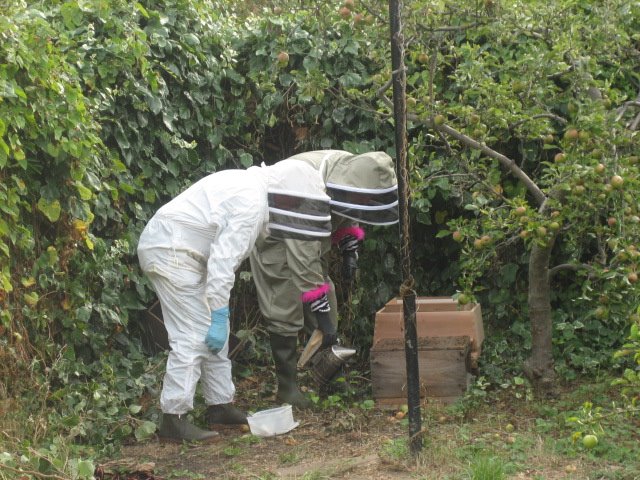
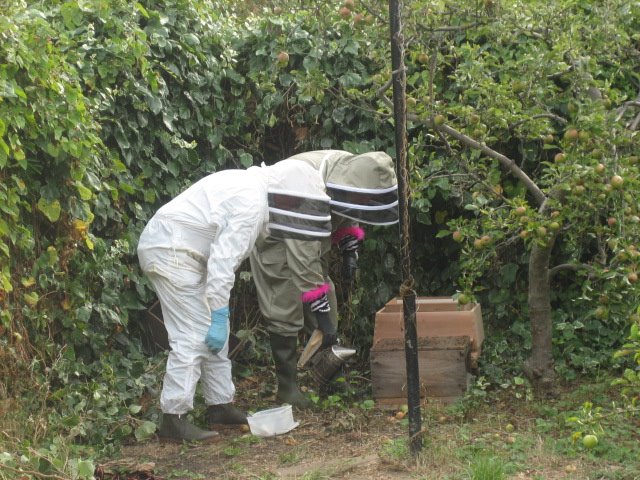
A public thank-you to Peter Bowbrick, former fireman and latterly Bee Inspector.
Not only did he find the bees from a local keeper, check that they were healthy, he also brought them round, he took time and trouble to show me what to do and how to do it.
Peter also runs the introductory course (with Charlotte Winterborn) for the Surrey Beekeepers' Association, and very good it was too (and only £35 for a six-week stint).
Pleasingly, Peter brought everything he needed - except he forgot to bring a hive tool. No-one's perfect, and it made me feel very slightly less incompetent (though I soon put that right).
16 August 2006
Making up syrup to feed the bees
My bees arrived late in the season. August is usually the time to take the honey crop out, and then leave the bees alone to build up their stores for the winter.
The first thing was to ensure that they have enough food, to help them build up both numbers of bees and honey stores.
The syrup is a one pound of sugar in one pint of water. This goo is then put in a bucket with a lid, and the lid has a gauze patch in it. You then turn the bucket upside-down and plonk it on the crown board on top of the hive (under the outside roof), and the bees can feed on the syrup through the gauze.
Simple, except to start with I got the proportions completely wrong, and when I turned it upside-down, it came straight through the gauze.
One sticky kitchen floor later, I figured that it's more like two pounds of sugar to a pint of water.
The first thing was to ensure that they have enough food, to help them build up both numbers of bees and honey stores.
The syrup is a one pound of sugar in one pint of water. This goo is then put in a bucket with a lid, and the lid has a gauze patch in it. You then turn the bucket upside-down and plonk it on the crown board on top of the hive (under the outside roof), and the bees can feed on the syrup through the gauze.
Simple, except to start with I got the proportions completely wrong, and when I turned it upside-down, it came straight through the gauze.
One sticky kitchen floor later, I figured that it's more like two pounds of sugar to a pint of water.
Sticking the bees in the hive
My hive is a WBC, the traditional-looking version with the slanted sides. The hive takes eight or nine (too busy to count) frames, and the bees arrived in a brood box from a National hive, which has one more frame than mine.
When the bees had calmed down, the first job was to take out one frame and make room to transfer all the others, inspecting them as we went, looking for the queen to make sure we had transferred her successfully.
First thing you notice - it's *very* hot in a full bee suit, even more so if you're a novice.
Eventually we found the queen, who was clutching on to the side of the old hive. Had we not found her, we might easily have left her outside.
Peter picked her up in a queen clip (a bit like a large hair clip, with enough room to let worker bees in and out, though not the queen) and then isolated her with a queen cage so he could mark her with a white dot.
The trick is to pick her up with the clip, then pop her back on a frame and trap her with the cage so you can mark her. In our case, Peter dropped her onto the frame - and she was off! She scarpered! I know I live near Wimbledon Dog Track, but this was ridiculous! Luckily we found her and marked her.
When the bees had calmed down, the first job was to take out one frame and make room to transfer all the others, inspecting them as we went, looking for the queen to make sure we had transferred her successfully.
First thing you notice - it's *very* hot in a full bee suit, even more so if you're a novice.
Eventually we found the queen, who was clutching on to the side of the old hive. Had we not found her, we might easily have left her outside.
Peter picked her up in a queen clip (a bit like a large hair clip, with enough room to let worker bees in and out, though not the queen) and then isolated her with a queen cage so he could mark her with a white dot.
The trick is to pick her up with the clip, then pop her back on a frame and trap her with the cage so you can mark her. In our case, Peter dropped her onto the frame - and she was off! She scarpered! I know I live near Wimbledon Dog Track, but this was ridiculous! Luckily we found her and marked her.


Arrival of the bees
The bees arrived, delivered by Peter in part of an old brood box (the bees, that is, not Peter). There are around 30,000 of the little buzzers, on ten frames.
We spent a few minutes arranging the new hive, ready to receive the new tenants.
Bearing in mind we had full bee suits on, Peter said, "When I open this, run!"
A comforting start to beekeeping.
We spent a few minutes arranging the new hive, ready to receive the new tenants.
Bearing in mind we had full bee suits on, Peter said, "When I open this, run!"
A comforting start to beekeeping.
| http://clipart-library.com/run-away-cliparts.html |
08 August 2006
Suits you
Full bee suits arrived. Plenty of pockets, robust zips with big ring-pulls on them for gloved fingers to grip, and not scary white.
When I opened the packet I was sure that XL would be waaaay too big for me. They looked enormous - made me think of the bit from ET with the guys in noddy suits. However, once on, they are pretty much the right size, though a bit short in the inside leg department (tight around the crutch, to be precise).
To give you a rough idea, I am 6 ft 1 in (1m85 to metric monkeys), almost 15 st (95kg). In future I will order one size up; I had forgotten that I am normally wearing jeans underneath. Or possibly I have a distorted body image...
Great piece of kit, and the service from BBWear was very good. http://www.bbwear.co.uk
29 July 2006
Bee suits in fetching sage

Though the Thornes beekeeper kit came with a veil, I have ordered two XL full beesuits in a fetching sage [light Olive Drab with a fancy name] finish from B B Wear.
The suits were about £85 each - excellent value, considering that's less than half a penny per bee...
I wanted camouflage pattern, but they're out of stock.
The suits were about £85 each - excellent value, considering that's less than half a penny per bee...
I wanted camouflage pattern, but they're out of stock.
Pic from http://www.bbwear.co.uk/
27 July 2006
Monumental excitement! Hive Arrival...
Amazing! A complete, ready-assembled WBC hive for my birthday - absolutely fantastic! - ordered and delivered right under my nose.
It's from Thornes (http://www.thorne.co.uk/index.htm) and comes with frames with foundation (the wax sheets ready for the bees to build honeycomb), gloves, veil, stainless steel hive tool and some mystery bits of wood and a peculiar plastic bucket.
There may have been instructions included; I unpacked it in a childlike frenzy of excitement, ending up with bits of hive all over the place.
On a commercial note, it's clearly an excellent piece of kit, and well made; the cedar and wax smell edible!
It's from Thornes (http://www.thorne.co.uk/index.htm) and comes with frames with foundation (the wax sheets ready for the bees to build honeycomb), gloves, veil, stainless steel hive tool and some mystery bits of wood and a peculiar plastic bucket.
There may have been instructions included; I unpacked it in a childlike frenzy of excitement, ending up with bits of hive all over the place.
On a commercial note, it's clearly an excellent piece of kit, and well made; the cedar and wax smell edible!